
The fail stroke needs
its own energy source.
Compare the operating principles of spring-return and reservoir fail-safe actuation, with attention to the torque that reaches the valve.
Two ways to retain energy for a fail stroke
Spring-return stores mechanical energy in springs. A reservoir fail-safe arrangement stores pneumatic energy as compressed air. Both are ways to drive a valve to a specified position when the relevant supply or control condition is lost; the complete control arrangement determines which event initiates that action.
Spring-return: powered travel works against the spring
Air pressure moves the actuator against the spring load during powered travel. When the chamber is vented for the return stroke, stored spring energy supplies the turning effort.
Read both sides of the spring-return torque data
The spring configuration must suit the selected air pressure. Increasing spring load can increase return torque while leaving less net torque for powered travel. Reducing spring load has the opposite tradeoff. Use the manufacturer’s published configuration and torque values at the selected pressure, rather than a double-acting rating for the same housing.
Check the available torque through both powered and return strokes. Spring-start torque is not spring-end torque. Where the valve must seat at the end of the fail stroke, the end-of-stroke value is particularly important.
Stored air: charge, retain, then route
The reservoir charges from the air supply during normal operation. A check valve prevents retained air from escaping back into a lost supply. The control device routes that stored air into the actuator when the specified fail condition occurs.
Why end-of-stroke torque is a separate rating
Stored air expands as it drives the actuator. Its pressure, and therefore the available pneumatic torque, decreases during the fail stroke. Easytork publishes fail-safe torque at the end of stroke separately from double-acting output. That is the value to use for the end-of-stroke fail requirement, alongside the full valve load profile.
Easytork coordinates the actuator, standardized reservoir and matched control accessories as a reservoir fail-safe arrangement. ESV, EPV and NTV provide different control interfaces for that architecture. The actuator’s fail-stroke energy comes from compressed air, even where a control valve uses a small spring to establish its own switching state.
Compare usable torque for the required duty
Compare the selected spring configuration with the selected Easytork fail-safe model at the applicable pressure. Use the valve’s actual torque requirement and required margin. Usable fail-safe torque depends on the selected model, spring or reservoir configuration, and operating pressure.
Questions to settle for either architecture
- Which event must cause the fail action: loss of air, power, signal, or a defined combination?
- What valve position and rotational direction must result?
- What torque is needed throughout the stroke, especially at the final position?
- What supply pressure and stored-energy condition are available before failure?
- What inspection and functional-testing requirements apply to the assembly?
Explore ESV, EPV and NTV operation →
See the torque change through the fail stroke
With supply maintained, normal double-acting torque remains approximately constant. A fully charged stored-air fail stroke starts near that output, then decreases as the air expands. Size the fail duty using the listed end-of-stroke torque and the valve’s load throughout travel.
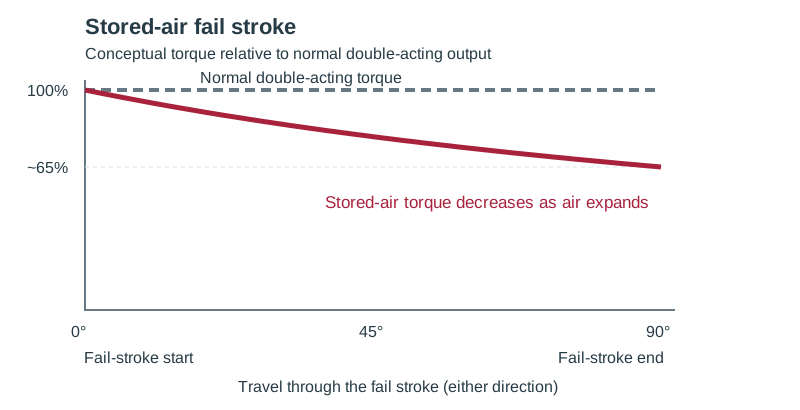
Stored-air torque follows the charged supply pressure
The reservoir charges from the available supply, so its available fail-stroke torque changes with charged pressure. It does not require choosing a different return-spring pack for each supply-pressure basis. A spring-return actuator’s return torque depends on its installed spring configuration, while its net powered torque also depends on supply pressure. For stored-air sizing, use the minimum charged pressure available before failure.
Catalogue torque illustration
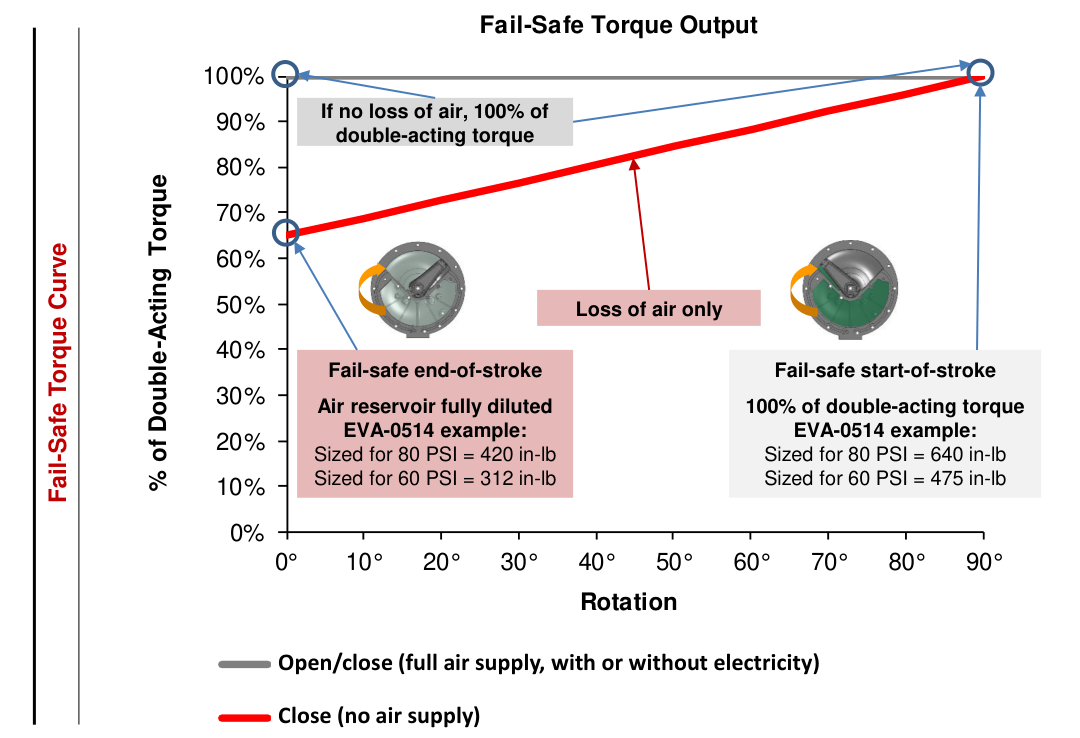
Read the model and pressure examples
The chart identifies EVA-0514: at 80 psi, fail-start is 640 in-lb and fail-end is 420 in-lb; at 60 psi, fail-start is 475 in-lb and fail-end is 312 in-lb. Values do not include a safety factor.
For EVA-0514 at the same pressure and equivalent configuration, these actuator torque magnitudes apply to either fail-open or fail-close operation; the direction of travel changes, not the listed torque ratings.
The illustrated fail-close direction does not define every installation. Use the selected model, charged pressure, control arrangement and required fail direction; check the valve’s full-stroke torque requirement, required safety margin and maximum allowable shaft torque.
Standardized reservoir integration
Reservoir fail-safe actuation requires an actuator, stored-air volume and a control path that retains and releases that air for the fail stroke. Easytork combines a standardized reservoir interface with matched ESV, EPV or NTV controls, so the components work as a coordinated package rather than a separately engineered reservoir circuit for each application.
The selected package still needs sufficient stored-air torque for the valve and the required fail direction. See how the control paths work →
Technical references
Work through your application
Bring the required fail position, failure event, air pressure and valve torque. We can review the arrangement against that duty.
Contact us →