
Where does the
actuator’s air come from?
Understand atmospheric breathing, Easytork’s instrument-air arrangement and what the distinction means in harsh and high-purity environments.
First, define which loop we mean
In this guide, open-loop and closed-loop describe the actuator’s air path and its relationship to the surrounding atmosphere.
Open-loop breathing: a changing chamber draws from its surroundings
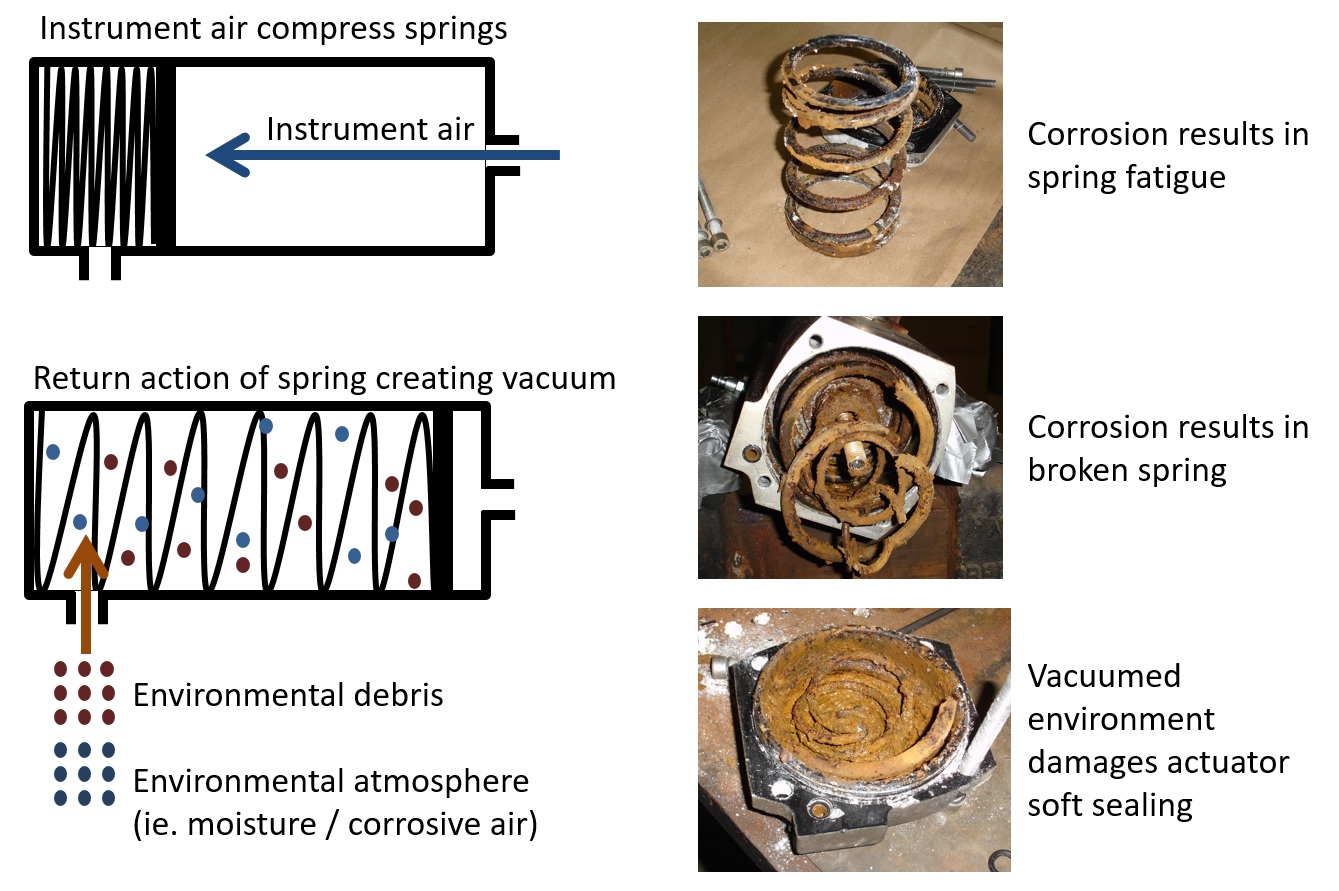
A conventional spring-return actuator commonly uses a 3/2 control valve to pressurize or vent its powered chamber. The separate vented spring chamber changes volume as the actuator moves: one stroke expels air and the other draws surrounding air in through its breathing path.
Why the installation environment matters
When the breathing path opens into a dirty, wet or corrosive environment, the incoming air can carry contaminants toward internal components. The actual exposure depends on the actuator design, venting arrangement, protective measures and operating conditions.
Easytork’s closed-loop arrangement: no actuator-return spring
Easytork uses stored air, not an actuator-return spring, to drive the fail stroke. The actuator works pneumatically in both directions; its ESV and EPV controls are fundamentally 5/2 arrangements. There is no return-spring chamber that must draw in surrounding air as that spring moves. In the Easytork fail-safe arrangement with ESV, EPV or NTV, instrument air supplies the actuator and charges the reservoir. The matched control routes air for normal movement and retained reservoir air for the fail stroke. It does not rely on atmospheric intake into a spring chamber as the actuator moves. “Springless” describes the actuator’s return mechanism; small switching springs may still be present in control components.
Follow the supply, retained air and exhaust
Two environmental questions, one air-path principle
A vented spring chamber can draw in moisture and contaminants. In suitable warm, damp conditions, accumulated contamination can support microbial growth; later cycles can expel contaminated air back into the surroundings. That matters in high-purity areas as well as dirty industrial environments. Easytork’s stored-air arrangement avoids this spring-chamber intake and exhaust pathway.
Keep the complete control arrangement intact
ESV provides Easytork electrical on/off control; EPV interfaces a third-party non-NAMUR 3/2 solenoid; NTV works with a double-acting positioner for modulating duty. Their connection requirements are part of the reservoir fail-safe system, not optional plumbing details.
Technical references
Catalogue environmental airflow comparison · ESV, EPV and NTV connections · Operating and fail functions
Review the air path for your environment
Tell us the operating environment, required fail action and proposed control accessories. We can help review how air enters, moves through and leaves the assembly.
Contact us →